Showing posts with label Components. Show all posts

Monday, April 28, 2014

New Vacuum Pump

Nearly 5 years ago, I installed ElectroJeep's power brake vacuum pump.  It was a noisy little beast, and it always irritated me.  Some time in the past 5 years, I got a new, quieter pump to replace it - the MES 70/6E2 - but I never got around to installing it because it was taller than the old pump and would not fit in the same spot.  However, with the new LiFePO4 layout, I had a blank spot where one of the 26 old AGM batteries had gone.  A perfect spot to mount both the new pump as well as the power steering reservoir:


The pump is mounted on little anti-vibration feet, and is much MUCH quieter than the previous pump.  I hooked it in to the original vacuum reservoir, which includes an adjustable vacuum sensor switch:


And now I have power brakes - in style!

Sunday, April 20, 2014

EMW EV Dashboard

I had previously installed a sender board for the EMW EV Dashboard Android app:


Today, I hooked up the BlueTooth module and got it calibrated and running to my taste.  Here is a screen shot:


It shows current (both analog and digital), voltage (both analog and digital), charge (both analog and amp-hours remaining), and power being consumed.  I drove about 5 miles around the section block - the app worked really well.  And it looks like my estimate of roughly 50 miles range is going to be accurate - I consumed about 7 Ah for the 5 mile range.  70% DOD from 100 Ah is 70 Ah - and 70 Ah * 5 Mi / 7 Ah = 50 miles.  To one significant digit.

Saturday, May 12, 2012

Coming Soon...

...to an ElectroJeep near you (or, at least, near me):


A pallet full of something.  What could it be?


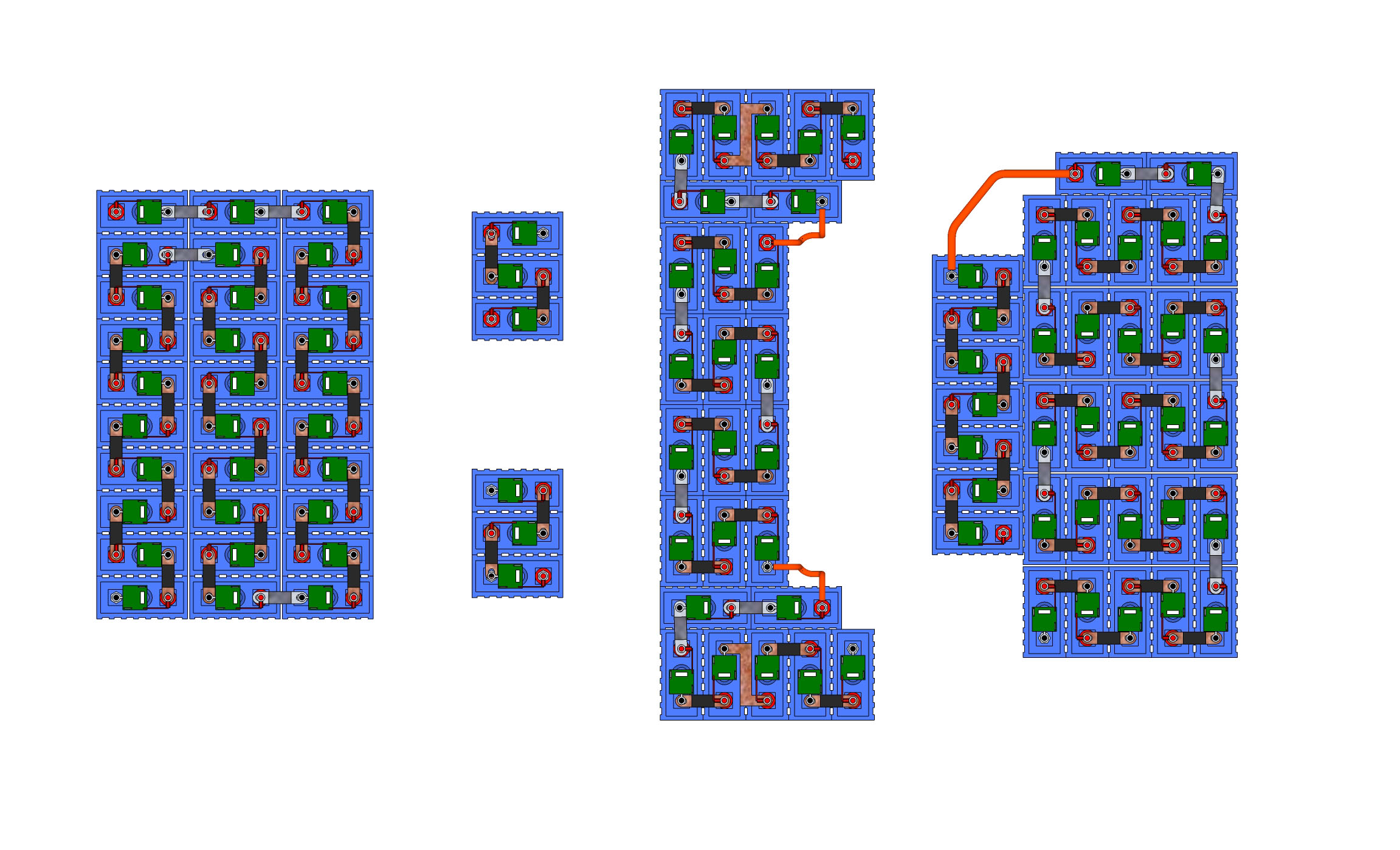
110 CALB LiFePo4 cells!  Each 3.2 volt cell stores 100 amp-hours.  The ElectroJeep will have 98 of them (the rest are for spares / redundancy).  Here is one possible layout (it fits in the existing battery racks):


98 cells yields a 313.6 volt nominal pack.  The charge voltage will be 352.8 volts, and the "empty" voltage will be 274.4 volts.  There will also be a BMS to keep any individual cell from becoming too full or too empty.  This compares well with the lead-acid 312 volt nominal, 371.8 volt charging, 275.6 volt empty stats.

Assuming 500 watt-hours per mile, and 75% depth-of-discharge, this should take the ElectroJeep over 45 miles range per charge.  My experience with the lead-acid was more like 10-15 miles per charge.  A significant upgrade, and almost 800 pounds lighter!

Saturday, August 9, 2008

Charger is here!

The charger arrived today. It took a while, but Ryan at EV Source was very helpful and honest about the delivery issues. It is a Manzanita Micro PFC-20. There are two neat features that this has over the Zivan NG-3. First, it can adapt to AC line voltages from 120 to 240 volts. Second, it has a built-in data bus interface which you can use for better equalization of batteries (especially important with AGM batteries).


This is the last major component to arrive. On to building battery racks and getting ready to string it all together...

Saturday, July 12, 2008

Electro Automotive Delivers

Back in May, Electro Automotive shipped me the profile plate, motor ring, splined bushing, and taperlock hub. Unfortunately, the splined bushing was too long and prevented the flywheel from being properly placed. In this photo, you can see how far out the hub stuck with the too-long bushing:


EA said, "send it back and we'll fix it" so I did, but before I sent it back, I took some measurements. The bushing was 1.75" long, as shown here:


When inserted into the hub, the bushing stuck out about 1/8 inch:


I sent them the hub and bushing a few weeks ago, and it showed up this week, all better! Here you can see that the new bushing is 1.375" long (a full 3/8 inch shorter):


When inserted into the hub, it now is about 1/8 inch below the top of the hub:


Here is a test fit of the bushing and hub - you can see that the hub is much farther back inside the profile plate. This should be plenty of room to adjust the flywheel distance.


I have to say, I have been very happy with Electro Automotive's responsiveness here. They have changed their operations to try to do a better job at order fulfillment, and it shows. Thanks, EA!

Friday, July 11, 2008

Cam-Lok High Voltage Connectors

In this posting, intergalactic mentioned the following valuable advice:

Don't use Anderson connectors. The SB50 and SB350 styles don't seal and if wet will short out and burn up. The connectors used for long welding cables or outdoor power supplies with the tapered rubber boots work well. Cam-Lok, I think.

After some googling, I found an online retailer (http://www.lightsonretail.com) who carried Cam-Lock style connectors which would work with 4/0 welding cable. These are rated for 400A at 600VDC, so should work well for the 312V Jeep. They are waterproof, interlocking, and very large.

On the left are the components for the female connector; on the right, the male:

This picture shows how the components interconnect:

And this picture shows the female connector with the cam component inserted:

I got enough of the connectors to isolate each major battery group so that I can work on lower voltages than 312V. I found 144V to be dangerous enough; I don't want to work directly on higher voltages if it can be avoided. Which it can by making each battery pack independently connect into the series with these Cam-Lok connectors.

Wednesday, May 28, 2008

Motor Adapter, and a Problem

On Monday, KatC and I worked on the motor adapter. First, we built a wheeled dolly as a work platform for the 100+ kilogram motor, and clamped the motor to it:


Next, we put the motor adapter ring on - the bolts will get torqued to 35 ft-lbs:


Next comes the profile plate - again, torqued to 35 ft-lbs:


And finally, the flywheel is attached to the hub - the hub is not tightened down yet, since we will need to adjust the flywheel-to-profile-plate distance.


The next step is to adjust the distance. Unfortunately, the closest we can get the flywheel to the profile plate is 1.62", which is 2/10" farther than the required 1.415" +/- 0.01". This is due to the fact that the splines on the shaft do not extend all the way to the motor, and this is as far back as the splined bushing can slide. I've sent email to Electro Auto to ask about options; as I see it, there are three main ones:
  • Add a 2/10" thick spacer ring between the motor ring and the profile plate
  • Machine the tapered bushing down so that it can slide farther back on the shaft
  • Add a 2/10" thick large metal gasket between the adapter plate and the transmission bellhousing
Doing nothing is not an option - 2/10" is plenty to interfere with the normal operation of the clutch / flywheel combo. I prefer the spacer ring because I think it will be the optimal cost / effectiveness option. But I'll wait and see what EA has to say before I take action.

Thursday, May 22, 2008

More Parts!

Yesterday, the transmission / motor adaptor came from Electro Automotive. Their build quality is excellent, as usual, and their delivery time was much more predictable than in the past (they apparently have made some changes in their order fulfillment processes). It still took a while, but the delivery time was within the expectations they set when I made the order. Here are the parts, laid out on my living room floor:


Here they are, with labels:


Here's a closeup of the taperlock hub and the tapered, splined bushing. I've already test-fit the bushing on the drive shaft - fits perfectly:


This all goes together as documented on Electro Automotive's web site, and as shown in my Volt914 build (toward the end of this post as well as this post). This weekend I hope to get the motor all assembled with this hardware, perhaps even with the new clutch mounted. Stay tuned...

Saturday, April 19, 2008

Batteries!

The batteries arrived yesterday - over 1500 pounds of them. They were nicely strapped & shrink-wrapped to a pallet:


Here is one of the batteries unboxed. It is a 12 volt, 80 amp-hour, 56-pound bundle of lead, acid, and plastic - the Concorde Chairman AGM-1280T:


And here are all 26 batteries, nicely stacked up and waiting for their Rudman regulators and Manzanita Micro charger:


I bought them from EFI Technical - Scott and John were extremely helpful - I give them an "A+" for customer support and service. They gave me a prompt quote, kept me informed of the manufacturing progress (these batteries are manufactured on-demand), and were very diligent about asking whether everything arrived correctly. Thanks!


EFI Technical
300 South Harbor Blvd., Ste 810
Anaheim, CA 92805


Saturday, March 8, 2008

Christmas in March

Over the past few weeks, quite a few parts that I've ordered have drifted in. From Quadratec, comes a variety of Jeep upgrades. First, a 2" Old Man Emu heavy load lift kit (shocks, coils, leaf springs, HW):


Second, a front brake overhaul kit (rotors, pads, HW):


Third, a rear brake drum-to-disc conversion kit (I'm not 100% certain this will fit the axle on my Jeep; if not, I'll upgrade the axle):


And fourth, a kit to convert the vacuum-actuated 4WD transfer case into a manual cable-controlled one:


Here are cable, connectors, and tools from Cloud Electric:


A vacuum pump kit (to operate the power brakes) from EV Source:


An electric power steering pump kit from Canadian Electric Vehicles:


Two 400V, 1000W ceramic heaters from Mor Electric / Infrared Heaters:


A PakTrakr, 5 remotes, a current sensor, and a computer interface (not shown):


And, finally, a complete workshop repair manual for my Jeep (including full electric diagrams) from Auto Books Bishko:


I have deliberately spread the orders around to a variety of EV parts providers. This is for three reasons: first, it limits the risk of any one of them completely messing up the build schedule. Second, it allows me to do my part to keep EV suppliers in business. Finally, it allows me to give feedback to people on their service and quality. So far, all of the suppliers I've dealt with have been prompt and responsive - no complaints from me!

I've contacted a local garage to install the lift kit and brakes - I don't think my skills add any value there. But everything else me and my wife and daughter will do ourselves!

Friday, February 8, 2008

Christmas in February

The shipment from Azure Dynamics arrived today. It was all attached firmly to a pallet and plastic wrap / strapped together. The total package weight was 330 lbs:


Here it is, all unboxed / unpacked sitting on the driveway:


I ordered the AC55 motor (weight: 106 kg / 233 lbs):


...a DMOC445 controller (same as in the Volt914):


A 312-V DC-DC converter designed to work with a backing battery:


And the interface kit, composed of this cool switch (which controls motor direction & power as well as regen braking and, just for fun, the electric heater):


...and this regen braking relay & wiring:


...and a throttle potbox & wiring:


...and the main wiring harness to the DMOC445:


...and various and sundry misc connectors, etc. for the above:


So, off to order the rest of the stuff. There are some basic upgrades to the Jeep:

  • Front disc brake replacement
  • Rear disc brake upgrade
  • Suspension upgrade (a 3-inch "heavy-duty" lift kit)
  • Cable switch to replace 2wd->4wd vacuum switch
As well as a long list of parts for the conversion:
  • 2/0 or 4/0 welding cable for high-current wiring
  • Charger
  • (maybe) 26 battery charging regulators (if I go with AGM)
  • 26 batteries (AGM or flooded)
  • Cable lug ends
  • Heater core
  • Power steering pump electric feed
  • Power brake system vacuum system
  • Lots of L-bar and square tubing to weld together for various supports
  • Material for battery boxes (possibly plywood, still debating)
  • Gauges, shuts, and such
  • Fuses & circuit breakers
  • Connectors, nuts, bolts, grommets, kitchen sinks, etc.
The Jeep upgrades are on order. Still evaluating the rest.

Thursday, February 7, 2008

Parts on the way, and motor notes

I got notification from Azure Dynamics that my controller, motor, DC-DC converter, and interface harness have shipped. They should arrive in Colorado tomorrow. I'll put pictures up when they get here; in the meantime, here are some notes on why I selected the motor I did.

Basically, a sports car (like the volt914) is designed with a gearing ratio that encourages higher RPM. A SUV, like the ElectroJeep, is heavier, and the tranny typically has a lower gearing ratio. So, I was looking for low-RPM torque, and not too concerned with high-RPM perf. Here is a chart I made that combined two charts from Azure (along with an estimated "AC24L" motor that TimK mentions in this post on his 914ev blog). This plots torque vs. RPM. Note the *much* higher torque at low RPM, but the lower torque at higher RPM. The crossover happens roughly at 3000-3500 RPM. Edit - I added data for the Advanced DC 9" motor for comparison purposes:


Most people are accustomed to thinking of motor performance in horsepower, so here is the same data recalucated for HP:


I think this chart illustrates well why the AC55 is suitable for truck / SUV applications, whereas the AC24 is much better for smaller, sporty cars. This higher torque / HP is going to be especially important for the Jeep, since its curb weight is 50% higher than the Porsche, and its battery weight will similarly be 50% higher.

Time to look into 4-wheel disc brakes...