Saturday, May 12, 2012

Coming Soon...

...to an ElectroJeep near you (or, at least, near me):


A pallet full of something.  What could it be?


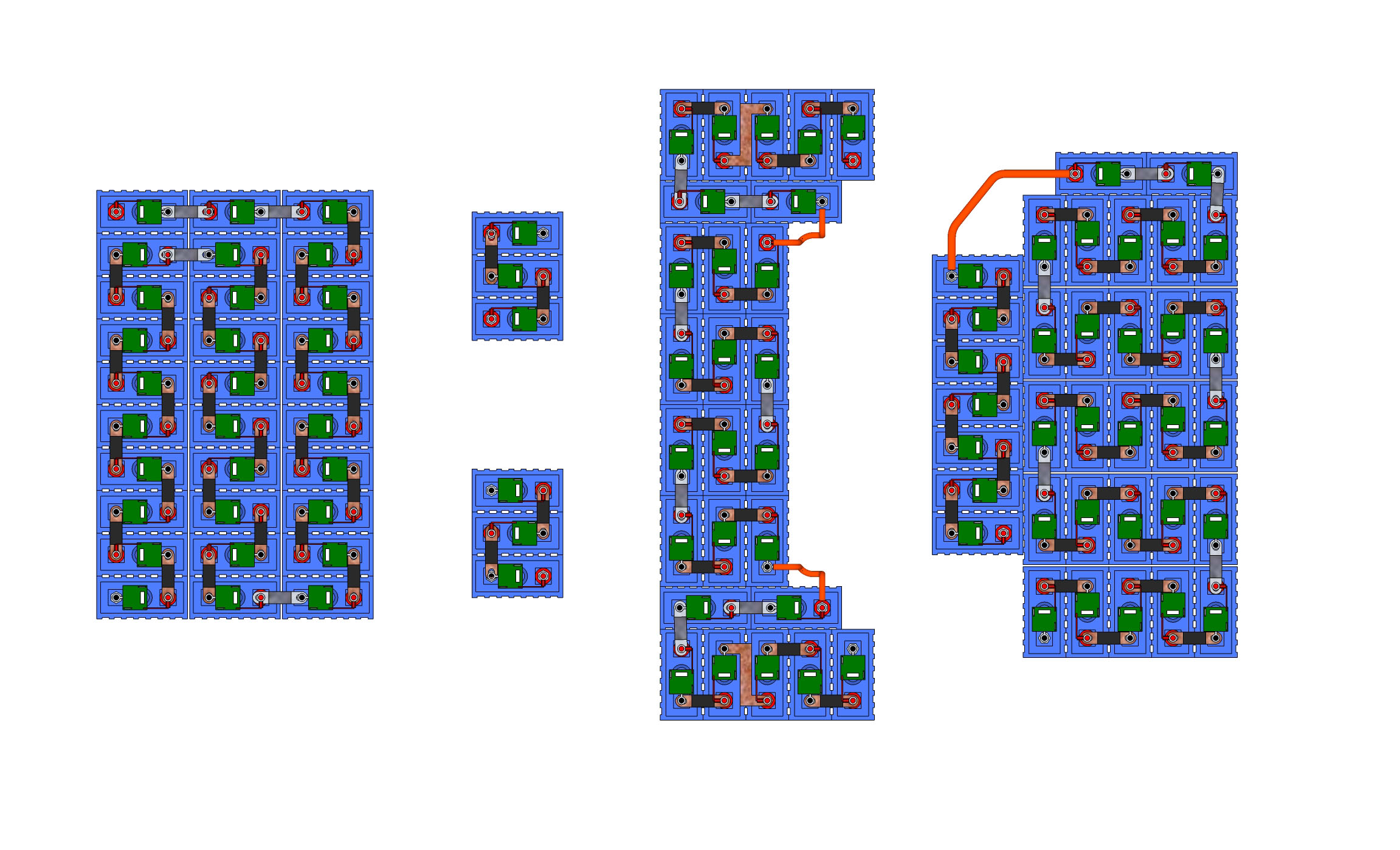
110 CALB LiFePo4 cells!  Each 3.2 volt cell stores 100 amp-hours.  The ElectroJeep will have 98 of them (the rest are for spares / redundancy).  Here is one possible layout (it fits in the existing battery racks):


98 cells yields a 313.6 volt nominal pack.  The charge voltage will be 352.8 volts, and the "empty" voltage will be 274.4 volts.  There will also be a BMS to keep any individual cell from becoming too full or too empty.  This compares well with the lead-acid 312 volt nominal, 371.8 volt charging, 275.6 volt empty stats.

Assuming 500 watt-hours per mile, and 75% depth-of-discharge, this should take the ElectroJeep over 45 miles range per charge.  My experience with the lead-acid was more like 10-15 miles per charge.  A significant upgrade, and almost 800 pounds lighter!

Saturday, September 25, 2010

Rudman Mk3 Digital Battery Regulators

The ElectroJeep has been a little idle as a project as I've been engaged in other things - such as upgrading the Volt914 to 216V.  However, with that out of the way, I've returned to it.  If you remember, the BMS I installed originally was a PakTrakr (scroll to the bottom of this page) with Zener diode regulators.  This sort of worked - but I was very nervous about putting full amps into the batteries, and the PakTrakr has the unfortunate side effect of draining the first in its string of 6 or so batteries.  Not a good combo - several of the batteries were getting seriously out-of-balance, and the Jeep was sitting at 325V after a "full" charge.

So, I finally got around to replacing that system with a much better one, based on Rudman Mk3 regulators from Manzanita Micro:

These are designed to connect to each battery.  In addition, they are connected to each other and to the PFC-20 (soon, PFC-30) charger to tell it when the battery is getting full.  I installed the older analog model on the Volt914 - the digital model lets you adjust the cutoff voltage dynamically, so I can actually charge the batteries correctly no matter the temperature.

The first thing to do was to make plastic boxes to keep the regulators protected.  I started by cutting little corner chunks out of 1/2" polyethylene:


The idea is to weld together a box around these corners, which themselves become the mounting points for the transparent covers.  I had previously obtained a plastic welding kit, which included the welder as well as various plastic welding rods (including polyethylene):


The boxes are of various dimensions, to hold different numbers of regulators.  After calculating dimensions, I cut out the basic shapes from 1/4" polyethylene, and then cut bending tracks where the sides will fold up:


Four of the corner pieces go on each box.  Here is one box, from the inside (before folding).  Note that the corner chunks of the envelope have been removed here:


Here is the same box from the outside.  I used 3/4" self-tapping screws (although I also drilled pilot holes).  These screws are mostly to hold it together long enough to weld, although I never bother removing them:


The next step is to fold up all four sides and then screw them to the corner pieces:


The corners are then welded (and a bit of the long fold is welded as well, to add strength).  Holes are drilled for cable egress, and smaller holes are drilled for the nylon screws which hold the regulators securely in the boxes:


And here are all seven completed boxes.  One of them has some of the wiring attached:


The next step is to attach the connectors which will allow me to easily connect and disconnect the boxes for servicing.  I use WeatherPak connectors - you can see them here grouped in the order in which they will be used in each box.  In addition, you can see the 12-gauge wire I use to hook the batteries to the regulator.  100 feet of red and 100 feet of black were just plenty:


Here is all the wiring complete.  I call this the "14-armed monster".  If you look closely, you can see that the internal phone-wire style interconnects are also attached:


Next step is to construct connectors to attach to the batteries.  A note on safety: before connecting the ring terminals to the battery bolts, it is safest to insert the pins into the shells - this prevents them from rattling around and perhaps making a circuit with another battery post:


Another note on safety - all the tools used near the batteries have been wrapped in electrical tape within an inch of their life.  Note that there are still a few exposed metal places - particularly on the torque wrench - to prevent from interfering from the operation of the tool.  Nothing is 100% safe, but every millimeter that is covered in tape is a millimeter that will not close a high-amperage circuit - I've experienced that once, I never want to try it again:


So, with the process established, it is just step and repeat.  Here is the lower rear battery box all wired up.  You can see that each battery has both a red wire and a black wire.  In the connector, the red and black wires alternate - this makes it easier to verify that they are correctly paired, and less likely to make a catastrophic mistake:


Here is the upper rear battery box, complete.  Note that, before connecting the batteries to the boxes, I use an ohm-meter to verify that the connections go where I think they go - better safe than sorry:


Here are the under-seat batteries and their regulators:


And here are the front batteries and regulators:


The next step was to interconnect the regulator boxes with the 6-wire phone cord, and then verify their correct hookup by flipping DIP switch 6 on the charger and turning it on (with the amp knob turned to zero).  Here are the rear regulators - the yellow lights indicate that they are all talking on the regulator bus:


Here are the under-seat regulators glowing:


And here are the 8 front regulators in the big box glowing:


And finally the lonely little battery at the end of the string with its regulator glowing:


With the regbus wiring verified, and the boxes closed up again and everything connected to enable the full 312V circuit, it is time to charge!  For a test point, I disconnected the DC-DC converter and used its HV input lines as a convenient place to plug in a multimeter:


In the rear, I used a clamp-on DC ammeter to verify the current going in to the pack (the new PFC-30 has a built-in ammeter so this step will not be needed):


You'll note that the ammeter says "10.02" - that's not a full load.  As I mentioned before, the batteries were significantly out-of-balance.  So, a few of them got to full charge first.  The most problematic were two batteries in the front compartment.  Here you can see me blowing a fan on them to cool them down - this helps the regulator dissipate excess current more effectively.  The overheating regulators are the ones with the glowing purple lights:


There were a few regulators in the back that also got hot, so I took the covers off and applied significant airflow to them.  Note the hot air gun at the lower right - it was turned to blow cool air, not hot air:


A combination of lots of cooling air along with turning the charger down to output 3 or 4 amps finally allowed things to settle down and charge.  Here you can see the green lights of several regulators in the back glowing - this means the regulators are bypassing current but not overheating:


At this point, the pack is nearing full.  We've reach 371 volts or so, and the constant current phase is over.  Now the charger switches over to constant voltage, ramping down the amps as it counts down on a timer.  I set the timer close to the max - the batteries seem to require it.  You do not want to cut off this phase prematurely, or the batteries will not be charged.  Here is the voltmeter monitoring the constant voltage phase:


Finally, at the end, the timer completed and everything was done.  The green, yellow, and blue lights on the charger are normal, and indicate that everything finished OK:


And here is the pack the next morning.  333.5 volts is by far the highest the pack has achieved in a year, and a significant improvement over the 325 volts or so it was getting before.  This is an average of about 12.8 volts per cell, which is where it needs to be:


This process will need to be repeated a few times before the batteries stay more balanced.  To facilitate that, I will be installing fans on all the regulator boxes (so I don't have to grab all the household fans every time I want to charge).  In addition, I will soon be upgrading from the PFC-20 to the PFC-30 charger.  This will allow me to charge at up to 30A input at 240VDC - which translates to allowing me to charge at 16A at 370VDC - 16A is the recommended C/5 charge level of the AGM-1280T.

This process took several hours per night over the course of a week.  And I'm exhausted.  But it is nice to be making forward progress again.

Wednesday, July 1, 2009

Full Sketchup model, updated

I have updated the full Sketchup model of the ElectroJeep and uploaded it to the Google 3D Warehouse. You can play with this preview image if you don't want to download Sketchup:


Click the "3D" button in the middle of the picture. You can then click the model and move the mouse left and right to rotate the view.

Saturday, June 27, 2009

Add-a-Leaf

Today I finally got around to fixing the sagging rear end. Although I had added a lift kit, the weight of 950 pounds of batteries in the rear end was just a bit too much for them. After thinking about it for a while, I decided to get an additional Old Man Emu leaf spring to insert into the pack.

The first step, of course, is the same as the original lift - remove the old springs. Jack up the Jeep and add heavy-duty jack stands. Also, put jack stands under the rear axle. Unbolt the shock from one side, let the axle droop (being careful to avoid breaking flexible lines), and then unbolt and remove the leaf springs, with a liberal application of elbow grease.

Here are the springs next to the add-a-leaf. The new leaf is nearly as long as the whole pack, designed to support the main spring. The "pointy" end goes on the rear, where the shackle attachment is. The "blunter" end goes toward the front:


To prevent sudden explosive unspringing of the pack, I clamped it and then unbolted the center bolt. I then gradually unscrewed the clamps, allowing the leafs to separate:


And here is the pack disassembled. The add-a-leaf is shown placed between the main leaf on the left and the rest of the pack on the right:


Assembly, as they say, is the reverse of disassembly. Before assembly, though, I applied liberal amounts of grease to the new leaf. To keep the leafs aligned I inserted a screwdriver in the bolt hole, and then clamped down. When it was clamped down tight, I removed the screwdriver and replaced the bolt. I then alternated clamping down even tighter, and tightening the bolt:


And then, I replaced the leafs on the Jeep. This went a lot easier than last time - not sure if I'm better at it, or if the year of sitting on them has made the leaf pack "remember" the approximate distance between the front and rear eye:


And here is ElectroJeep, all happy and level with its new add-a-leaf. It rides very nicely, now, too!


Edit (Jul 31 2009)

By request, here is what the Electrojeep looked like before the add-a-leaf (this photo is from a post in January). It actually got a bit worse after this - I added 1.5" spacers to the front springs to get more clearance above the front differential. Unfortunately, I don't have any pictures of the whole Jeep at that point.

Friday, June 26, 2009

Gauges, and legal to drive!

Over the past week, I've squeezed some 12V wiring work into odd moments here in there. This all culminated in getting the dashboard gauges (mostly) in place. It all started with the main cluster. Before putting it into place, I needed to splice connections into this connector, which fits into the gauge cluster to make the lights work:

The connections on this connector are as follows:


+----+----+
Gnd -+ 1 | 18 +- Illum
+----+----+
Left Turn -+ 2 | 17 +- Hi Beams
+----+----+
n/c -+ 3 | 16 +- Right Turn
+----+----+
Gas A -+ 4 | 15 +- Keyed +12
+----+----+
Oil -+ 5 | 14 +- Gnd
+----+----+
Gas C -+ 6 | 13 +- Illum
+----+----+
Illum -+ 7 | 12 +- Batt
+----+----+
Gas Tank? -+ 8 | 11 +- Water
+----+----+
Gas Tank -+ 9 | 10 +- Illum
+----+----+


I spliced in connections for the new gauge lights (the red and black cables - into wires on pin 1 and 18), and a connection for the gas tank light, which will light up when the Jeep is plugged into the wall and the key is turned on (i.e. - don't drive away you idiot!):


I then hooked in a 3-way wye into each of the illumination splices (there are three new gauges):


I also pulled all the wiring through the bulkhead into the gauge area. It made quite a spaghetti mess. Note the circular "thingy" toward the left side (inside the oval hole in the white surface). That is the original mechanical speedometer cable. It was the source of much, umm, "amusement" down below...


Underneath, I needed a good source of keyed +12V. Turns out this orange wire is keyed, and normally drives power door locks and power windows. I have neither, so this wire is actually very under-used. So I spliced into it for the brake relay and 312V ammeter:


Back in the engine compartment, I made looms out of the control wires, and put flexi-guard around them:


I removed the original bulkhead grommet, and enlarged the hole so all the wires could pass through it. Removing the grommet was highly entertaining, as it apparently was molded into place on the original wiring harness... but with enough cutting & hacking & cursing, I got it out and modified:


And here it is back in place, with a generous dollop of silicone sealer around everything. I also added sealer to the original hole where the throttle cable had gone (the square hole toward the lower right):


Back in the cabin, I neatened the spaghetti explosion into a loom and added flexiguard here too. This is especially important to protect those 312V wires that control the volt meter - although they are fused, I hate to risk more damage than necessary:


And here is the gauge cluster snapped into place. This was actually a *lot* more work than it sounds. It was a real pain to get the gauge cluster electrical connectors plugged in - despite the loom organization, the longer 16 AWG wires kept getting in the way. And then, the speedo cable was a *real* royal pain to get back into place. I finally found that unscrewing a mounting screw down under the engine gave me enough slack that I could pull the cable forward and get it to snap into place. It took me 15 seconds to type that. It took me 2 hours to figure that out and do it:


I then put the cluster face on, along with the 12V ammeter and 12V voltmeter. Here is everything plugged in and lit up. Note the ammeter showing about 40A - that's power steering plus power brake pump plus headlights plus turn signal plus brake light. Not too shabby. The DC-DC converter puts out 55A. I should almost never tap into the aux battery:


With all that in place, the ElectroJeep is now fairly road-worthy. So I took it on the road. I took it down to our local Jeep dealer and had a VIN verification done. I then took the paperwork down to our local county courthouse DMV, and got the Jeep retitled as Electric! Note the circled "FUEL E" designation. Unfortunately, they will mail me the actual title, so I don't have an image here, so the registration will have to do:


And here is the license plate with its new registration tags - all ready to drive legally on the roads!


One more note - I drove it about 11.6 miles round-trip to get the VIN verification done. It took roughly 4.6 KWh to recharge the batteries after I got home. This translates to 400 watt hours per mile from the wall - which compares pretty favorably with 379 watt-hours per mile for the volt914. Of course, I was driving 25-30 MPH the whole time, but I do not have the regen braking hooked up yet. So 400 is probably the right number. This translates to a range of roughly 50 miles at 80% DOD. We shall see...